This text is meant as a preliminary and incomplete research report on an artistic research approach still taking shape. It lays out the questions, places, and image-problems from which my project MATERIAL MEMORY will develop within the research group Energy – Digital & Decentral, and offers an interim snapshot of where things stand.
The text follows several lines of inquiry. At first the central question was which levels of the energy system are even accessible to film at all. Out of that grew a preoccupation with invisibility, access restrictions, and later with the image politics of the energy industry. A temporary focus on AI image generation and its energy consumption served as a methodological starting point, but was abandoned over the course of the research. Right now the project is condensing around the question of how the entanglement of energy data, digital control, and energy infrastructure can be examined filmically through artistic research.
Where engineers, computer scientists, and sociologists can evaluate energy data and interview transcripts directly, my starting point is a different one. I am a media artist and filmmaker working as an artistic researcher within this group. In terms of content, my way in is closest to the sociological approach, since I too am interested in power relations, questions of access, and the invisibility of infrastructure and of the social.
A new ordering of the research movements
- Methodological starting point: Follow the Object
- Theoretical impulse: Steyerl’s thermodynamic flip side of AI-generated images
- Methodological problem: visibility, access, KRITIS, montage, Brecht–Benjamin
- Current guiding thread: copper, SüdOstLink, archaeology, energy infrastructure
- Open filmic question: what images can come of this?
1. Methodological starting point: Follow the Object
On an earlier project, Configuration Drift, I dealt with nickel mining, smelters, rare-earth refineries, and Western hyperscale data centers in Indonesia and Malaysia. One image in particular stuck with me: a man sitting on the broken replica of a Roman column. All around him was massive nickel extraction. He crouched on the column, one hand under his chin like Rodin’s Thinker, a hammer in the other, with which he kept striking the column beneath him. I wasn’t sure how to read the image, but it burned itself into my memory.
Driving past, I didn’t photograph him. Later I tried to reproduce him with the help of an “image AI.”[1] Out of this memory, that is bound up with research into the critical raw materials behind the electrified mobility transition of Western industrial nations (nickel is used in particular for car batteries), comes the question, and at the same time the experimental setup, that drove the initial phase of the research:
What is set in motion — materially, energetically, geopolitically — when an AI-generated image comes into being, and how does the context of my memory connect to it?
I wanted to place this method at the beginning of a narrative, because it gets something going; it is a narrative vehicle that states the question clearly from the start while still able to take several different paths, and that maps an energy supply chain at its core. The starting point of my research was therefore a methodological “Follow the Object.”
In doing so I deliberately follow the networking and parallelism of energy and data, and trace how energy flows, data streams, economic interests, materials, and infrastructures spin a web across regions, companies, and time periods — from the wall socket to the local substation, on to the next transformer station, into the transmission grid. An approach like “Follow the Object” makes clear that we are dealing with different kinds of data: that of the “image AI” and that of the power grid. Data accrues alongside the grid and forms its own object of investigation. To that extent my work requires a decision about which data I will follow, and whether my narrative plan of generating an AI image is even necessary in order to trace an energy and data (supply) chain.

A man sits in the pose of Rodin’s “The Thinker” on a artificial column ruin in the middle of a dilapidated house. In the background, heavy construction machinery digs into the deep-red, terraced earth of a massive nickel open-pit mine.
Gemini_Generated_Nickel_mining_Rodin_pose_roman_ruins_reproduction_ruined©emerson.jpg)
2. Theoretical impulse: Steyerl
For the next stage of my working process, Hito Steyerl’s thinking about the production of digital images with generative image models was an important impulse.
In her essay collection Medium Hot (2025), Steyerl fundamentally shifts the frame for thinking about digital images. Her central argument concerns a paradigm shift in image-making itself: from an optical paradigm based on causality to a thermodynamic one based on probability.
According to the teachings of traditional optics, the path of every photon can in principle be traced back to its origin. In a thermodynamic environment — in diffusion models — “probability takes the place of causality: ray-casting is replaced by fore-casting.” (Steyerl 2025: 51)
What Steyerl lays bare here is the material flip side of this image logic: the shift from the optical to the thermodynamic paradigm is not only an aesthetic one, but above all an energetic one. Diffusion models are computationally intensive because they don’t depict, they reconstruct out of statistical noise. Every generated image is the result of thousands of computational steps — and thus of real watt-hours. Language models that produce text are already energy-hungry. Multimodal systems that additionally “see,” classify, and generate consume many times that energy. Silicon Valley’s AI engineers justify this development with an anthropomorphic argument: an artificial general intelligence must perceive the world the way a human child does — that is, it must be able not only to read it but also to see it. (LeCun 2022, pp. 3–4, sections 2.1–2.2 and fig. 1.)[2]
According to a study by Hugging Face and Carnegie Mellon University, generating one AI image consumes on average around 2.9 Wh — more than sixty times the energy of generating a text with comparable models (Luccioni et al. 2024). Image-generating AI is therefore not simply more energy-intensive than text generation; it operates on a different order of magnitude. In Germany, data centers consumed around 20 TWh of electricity in 2024 — roughly 4% of gross electricity consumption. By 2045 it could be 80 TWh (16%) (BMWK 2025). The energy transition is being optimized by digital systems, even as digitalization itself becomes the new large-scale energy consumer.
3. Methodological problem: visibility, access, KRITIS, montage
In order to make this flip side of the image logic visible again in images, in my film, I identified, at the start of my research, five levels worth investigating, along which a filmic form of narration might become possible in the context of the decentralization and digitalization of the energy grid. These levels are variants of visible and potentially documentable entanglements of digitalization and energy. Concretely, what crystallized was: (1) digital infrastructure, (2) physical infrastructure, (3) construction works in the context of expanding the transmission grid, (4) people and their labor within the energy system, (5) energy as a commodity, with its corresponding trading and business models.
Here, when it comes to visualizing — or rather the invisibility of — energy, one thing should be kept in mind: what you can theoretically see is the physical infrastructure — switchgear, transformer stations, power plants, storage facilities, data centers, and the hardware of the grid control rooms. Energy can be measured, visualized, and observed here through certain interfaces. What you cannot see as such is the digital logic and the software behind it: the grid control systems, virtual power plants, digitized data, and control algorithms.
On top of this comes a second layer of invisibility: even the actually physical sites, such as control rooms or data centers, have become increasingly inaccessible in recent years due to heightened security requirements (KRITIS) — something my research so far has confirmed.
Since the Russian full scale invasion in Ukraine, energy infrastructure has increasingly counted as critical infrastructure (KRITIS), which also makes it hard to reach for documentary and artistic research. Requests run aground on security concerns, trade secrets, and a wariness of the media. Requests that might once have met with openness now regularly fail. Concretely: requests to visit 50Hertz, the SüdOstLink construction site, power plants and grid operators in the region, the EEX energy exchange in Leipzig, and virtual power plant operators in Saxony went unanswered or were declined with reference to their KRITIS classification.
Where KRITIS classification, trade secrets, and geopolitical charge converge, individual barriers to access turn into structural invisibility. Structural invisibility is not a neutral fact but a particular form of decision-making power.
In his Little History of Photography (1931, p. 383), Walter Benjamin passes down a remark by Bertolt Brecht that, when it comes to the visibility of infrastructure, still holds true for me today:
For the situation, Brecht says, is made more complicated by the fact that, less than ever, does a simple rendering of reality say anything about reality. A photograph of the Krupp works or of the AEG yields almost nothing about these institutions. Actual reality has slipped into the functional. The reification of human relations — the factory, for instance — no longer gives those relations up. So something does in fact have to be constructed: something artificial, something staged.
What Brecht formulated for the photograph of the Krupp works holds all the more for today’s energy infrastructure: a photograph of a transformer station says nothing about the grid it carries. A drone shot of a data center says nothing about the electricity that feeds it, the raw materials it presupposes, or the conflicts it fuels.
My aesthetic principle is the montage of image, sound, and text — the “staged,” the contextualizing, rather than mere retelling or depiction.
As a filmmaker, though, I prioritize the image over information (text or data), because pure information, to my mind, is better housed in a text than in a film. In film I get to choose the relationship in which image, text, and sound stand to one another. While I can always tuck a piece of information into a voice-over or an interview, the distinctive thing about film is telling in images. My artistic research at present therefore consists of finding situations, images, stories, and thoughts that sit within the context of my “five-level model” and can be brought together through montage in an essay film.[3]
Large construction projects in the landscape, or processes of transformation, can usually be documented; you can talk to people about their work; experts can say something about digitalization; business models can be analyzed and narrated up to a point, but KRITIS as well as trade secrets, digital data, and energy flows are hard to show or to narrate. These tend to be illustrated, animated, or abstracted in schematically simplified form.
Since this kind of illustration or abstraction is also practiced by (virtual) power plant and grid operators and their marketers, I add a sixth level to my considerations: that of the advertising images, corporate and product films of energy companies or their suppliers. It’s worth examining which visual motifs, which combinations of images, which narrative forms and protagonists[4] are used in order to present oneself as a company — as the picture of a vision for the future, or else as a reaction to the public perception of individual companies or of the energy transition as a whole.
As you can tell, my way of working is always process-oriented, in search of the right relationship between content and form. That is time-consuming and demands a consistent questioning of the obvious idea, and of the image- and narrative-fantasies inscribed in our common consciousness. The process is always experimental, in the sense that all I can really build is an experimental setup (the five-level model) and then try, as best I can, to arrive at results along the lines of my project. Original idea and final result often diverge sharply in form, while the content, by contrast, gains depth — and, at best, new connections emerge.
4. Current guiding thread: copper, SüdOstLink, archaeology, energy infrastructure
In the end, the levels are taking concrete shape as follows. For one thing, I was fascinated by the material bridge between copper — one of the first metals humans mined and traded, one that tells us, through archaeological digs, about regional ways of life thousands of years old — and its role today: as a high-tech cable laid underground, carrying offshore wind energy from the Baltic Sea to the industry-heavy south of the country. In my six-level model I’d file this construction project under (3), “construction works in the context of expanding the transmission grid.”
Through survey work, archaeologists are checking the route that NKT’s direct-current underground cables will take between Wolmirstedt and Bavaria for the SüdOstLink expansion. My requests to the grid operators 50Hertz and TenneT, as well as to the state heritage offices (Saxony-Anhalt, Thuringia, Bavaria) through whose territory the SüdOstLink underground cable runs, went unanswered. A site visit and filming have therefore not yet been possible.
The region’s most prominent archaeological find (Saxony-Anhalt, 1999) is the at least 3,700-year-old bronze sky disc (Himmelsscheibe von Nebra) made of 97.5% copper and 2.5% tin, which documents the position of sun, moon, and stars in a leap year and thereby fixes the moment for sowing. Existential information for that era. A mnemogram: a physical memory store for astronomical knowledge tied to power. A document as an instrument of power. The long-distance trade of the Bronze Age spun a web across Europe along which copper traveled — the same metal that today carries the energy of the future in underground cables. An underground cable as a link between prehistory and the future — a good image.
A sky disc that extracts information from a celestial constellation and reproduces it in the form of a copper disc, thereby making it transmissible, is a precursor of what we today call digitalization and, more precisely, datafication — the abstraction or transformation of world and life, and potentially of all its elements, into the production and evaluation of data for the control and steering of processes.
So MATERIAL MEMORY is also to be taken literally: copper serves me here, in a figurative sense, as a guiding thread — the material has, in a way, a memory. It carries the traces of its origin: from ore, from open-pit mines, from extraction zones.

The photograph shows an infrastructure construction site in a vast agricultural landscape. In the center of a deep trench, two thick, bright-red empty conduits for underground cables (SüdOstLink) have been laid, surrounded by earthen embankments and construction fences. (Tag_der_offenen_Baustelle_50Hertz_SüdOstLink_39171_Sülzetal©emerson.jpg)
5. Open filmic question: what images can come of this?
The idea for one concrete image level is to build a more thoroughly documented basis spanning the manufacture of the underground cable, the archaeological survey work, the specialized heavy haul transport of the individual cable segments, the laying of the cables, and the analysis of the metal finds. Further image and text levels will come out of visits to the distribution grid operator Netz Halle; out of conversations with experts on the question of whether it’s better to expand the grid or to bet on further digitalization, “smartification,” and thereby regulation; and out of an image analysis that will turn filmic means on the marketing strategies of energy producers.
Further developments will be presented in a later blog post.
At the time of finishing this text, I was denied access both to the control room of Netz Halle and to documenting the specialized heavy-haul transport of the underground cable for the SüdOstLink expansion.

Abstracted, vectorised rendering of the Nebra Sky Disc (~1600 BCE). With numbered power-thesis markers, and manufacturing notes from Dieck et al. (2024). Source: Emerson Culurgioni / Material Memory, 2025. Data: Schlosser, Meller, Hansen, Pernicka, Dieck et al., UNESCO
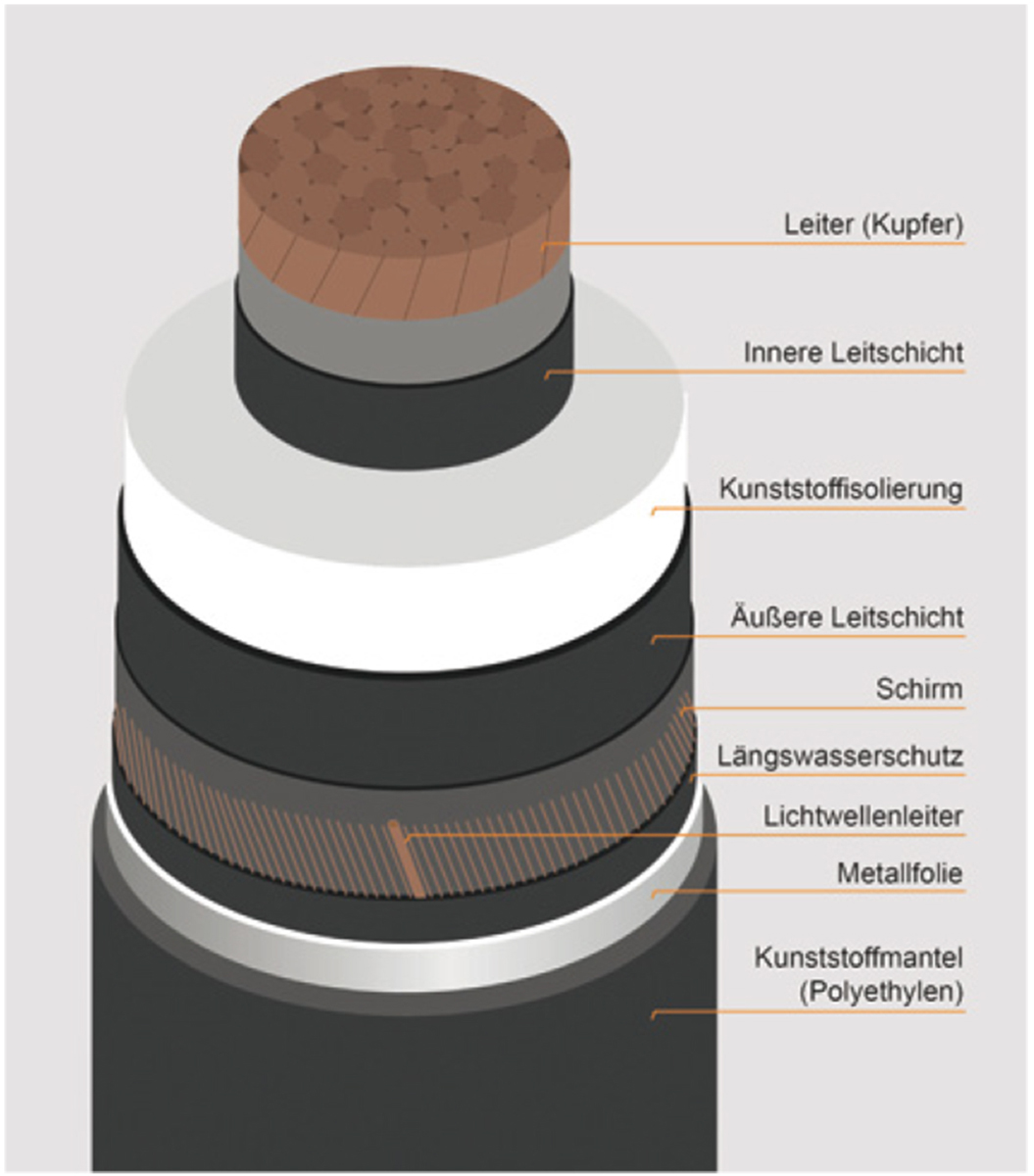
Cross-section of an HVDC cable for the SüdOstLink (50Hertz/NKT), computer-generated cutaway. Total diameter approx. 14 cm. Source: 50Hertz Transmission GmbH / Jan Pauls
[1]“Image AI” is not a technical term here but a simplifying label for generative image models, in particular text-to-image systems and diffusion models. What’s meant are machine-learning methods that generate new images on the basis of large image-text datasets and statistical probabilities. The term is imprecise, because neither a single “AI” nor any conscious understanding of images is at work, but rather a complex interplay of model architecture, training data, computing power, prompt, and output procedure.
[2]According to Yann LeCun (Chief AI Scientist at Meta, now founder of the startup AMI Labs), a small child acquires its model of the physical world (object permanence, gravity, etc.) through high-bandwidth observation alone, whereas a text LLM learns only from linguistically encoded knowledge and therefore remains “ungrounded.” Cf. LeCun, A Path Towards Autonomous Machine Intelligence, OpenReview, 2022. Publicly, on LinkedIn (January 2024) and in numerous talks, he has made the following argument: in four years a child has taken in roughly 50 times more data through vision than the largest LLMs have through text; text is too narrow-band and too sparse a modality for learning how the world works. At an MIT event he put it this way: that a four-year-old has seen, through vision, as much data as the largest LLMs have through all publicly available text. On top of this there is Fei-Fei Li (Stanford / World Labs): “There’s no language in nature” — language springs from the human mind, while the world is far more complex. Her conclusion: AGI is not complete without spatial intelligence (that is, learning through images), and this is exactly the problem she wants to solve.
[3]There is some disagreement about what essay film is or is not: it’s also known as the non-genre. Derived from the literary genre of the essay, it carries the French word essai, meaning trying. Essay films often have a personal, historical, or intellectual approach overlapping with the point of view and intention of the author. At its core is the work with the three elements text, image and sound. … Coming from the tradition of documentary-filmmaking, essay films have the tendency of a specific research-approach both concerning the selection of the material and the relation between form and content: i.e. the use of documentary-, found-, media-footage, and archive material. Its often experimental approach marks its artistic character and therefore deals with every kind of material in contrast to conventional filmic, more homogene formats. Its montage and dramaturgy are constructive, dialectic or associative rather than the continuity and determinism used in conventional fiction films. — Syllabus, Bard College “Essay Film – As a Documentary Strategy,” Seminar Leader: Emerson Culurgioni
[4]Here I’m referring, for example, to this cinema-commercial by Vattenfall featuring Hollywood superstar Samuel L. Jackson:https://www.youtube.com/watch?v=3uEpdIKzspA Offshore wind farms are built by huge multinational energy corporations with large marketing budgets. The solar market, by contrast, is highly fragmented. It consists of countless regional installers, Asian hardware manufacturers, and start-ups. For these firms a multimillion-dollar Hollywood campaign simply isn’t worth it. Besides, advertising for PV systems is more sales-oriented.
Bibliography
Benjamin, Walter (1931): “Kleine Geschichte der Photographie.” Gesammelte Schriften, Bd. II.1, p. 383.
IEA (2025): Global Critical Minerals Outlook 2025. Paris: IEA. DOI: CC BY 4.0.
Luccioni, Alexandra Sasha / Jernite, Yacine / Strubell, Emma (2024): “Power Hungry Processing: Watts Driving the Cost of AI Deployment?” In: Proceedings of FAccT ’24. New York: ACM. DOI: 10.1145/3630106.3658542.
Mejias, Ulises A. & Couldry, Nick (2019): Datafication. In: Internet Policy Review 8 (4). DOI: 10.14763/2019.4.1428.
Steyerl, Hito (2025): Medium Hot: Bilder in Zeiten der Hitze. Zürich: Diaphanes. [English ed.: Medium Hot: Images in the Age of Heat. London / New York: Verso, 2025.]
Yann LeCun (2022): A Path Towards Autonomous Machine Intelligence, Version 0.9.2, 27 June 2022, OpenReview (ID: BZ5a1r-kVsf). → openreview.net/pdf ; ai.meta.com/blog/yann-lecun-advances-in-ai-research/
YouTube video link: uncensored version with Samuel L. Jackson — A Taste of Fossil Freedom.
Funding
The project is funded by the European Union (JTF).


